Pages

Showing posts with label infrastructure. Show all posts

Bina Puri upbeat on cracking RM1b mark

ADS
The company expects 2011 to be one of its better years since its listing in 1995, says Bina Puri's group managing director

BINA Puri Holdings Bhd, which is expanding its business, is bullish that revenue will surpass RM1 billion this year, its chief said.


"This year is all about execution of projects and finishing existing jobs. We expect 2011 to be one of our better years since our listing in 1995," group managing director Tan Sri Tee Hock Seng told Business Times.

In 2010, Bina Puri secured projects worth RM2.5 billion. Among the contracts it won were the Ampang light rail transit line extension, the low-cost carrier terminal in Sepang, the Kuala Lumpur-Kuala Selangor Expressway privatisation project and building ramps and a main line bridge for the Eastern Dispersal Link in Johor.

The company hopes to maintain the rate of new contracts this year by securing RM2.5 billion worth of work.
It has bid for building and infrastructure projects worth over RM2 billion, in Malaysia, Thailand, Brunei and the Middle East.

For the nine months ended September 30 2010, Bina Puri posted a net profit of RM8.13 million on revenue of RM861 million. In 2009, Bina Puri made RM6.4 million on revenue of RM780.1 million.

Tee said the company's order book of RM3.3 billion will help improve its earnings for the next two to three years.

Meanwhile, Tee said Bina Puri is on a drive to expand its property division, which contributes less than 10 per cent to its revenue and net profit.

Bina Puri ventured into property development in the 1980sas a boutique developer.

Some of its prime projects include Bukit Idaman township in Selayang and Jesselton Condominium in Kota Kinabalu, Sabah.

Tee expects contribution from the division this year to be in the region of 15 per cent with RM900 million worth of housing projects in Klang Valley, Johor and Sabah.

"We want to expand the division because of the higher margins that can be made from property development. We don't want to be too dependent on construction, which is harder to take on," Tee said.

By Business Times

ADS

All eyes and ears on second MRT

ADS

KUALA LUMPUR: The second mass rapid transit (MRT) line, which circles the Kuala Lumpur city centre (KLCC) orbital and known as the “circle line”, is already in the final planning stage.

The details are expected to be announced in March.

“Its alignment must depict the current and future business districts in Kuala Lumpur,” said Minister in the Prime Minister's Department and chief executive officer of Pemandu Datuk Seri Idris Jala during an Economic Transformation Programme (ETP) update to analysts and fund managers recently.

In the longer term, a third line to Port Klang was being comtemplated, he said. The circle line is expected to cover the hotspots surrounding the KLCC, Jalan Bukit Bintang, the new Kuala Lumpur International Financial District in Dataran Perdana, KL Ecocity, Pusat Bandar Damansara and Sentul, among others.

Meanwhile, the “blue line” the first line which is a 50km alignment that covers Sungai Buloh to Kajang, via Pusat Bandar Damansara and Bukit Bintang is slated for completion in 2016. The network of all the three MRT lines will be fully operational by 2020.

“Greater KL now has a population of 6 million people. By 2020, we will have 10 million people. If we don't have the MRT, the city will be choked. Right now, nearly everybody drives. This is not sustainable,” said Idris.

He added that currently 13% of people commuted using urban transportation. Under the ETP, Idris said this should increase to 50%, adding that the funding structure for the MRT would be disclosed by end-February.

“Apart from reducing travelling time, the MRT will also cause property prices to appreciate because of better accessibility. If your house is near the MRT station, prices will go up because of the commercialisation created around the area,” said Idris.

Some analysts are wary of the ambitious plans laid out by Pemandu.

“As usual, it's a case of execution. Will the Government be able to actually implement the project? We'll need to see it being done to believe it. More importantly, how is the Government going to fund this project?” asked a construction analyst.

Another analyst said the Government was likely to reduce cost by getting developers to co-fund some of the MRT stations.

On implementation, he said that Pemandu would have learnt from past lessons of the LRT, monorail and commuter train.

Some brokers have notably been able to analyse the impact of the proposed MRT comprehensively.

In a Malaysia Market Strategy Report titled “Property boom-boom” released on Jan 26, global investment bank UBS' head of research Chris Oh said Malaysia was set to enjoy improved connectivity in the coming years with the proposed infrastructure rollout of the MRT system and possible high-speed rail linkage between Kuala Lumpur and Singapore.

He said the MRT captured the imagination of the people, developers and investors. He expects property value around a radius of 20km of the city centre to rise significantly.

The preference would be on developers who have vast landbank with high-density mixed development around MRT stations.

“Interest in Malaysian property will be fuelled by foreigners looking out for higher returns (via undervalued currency and low entry costs) than their home countries (Singapore and Hong Kong) and the absence of significant restrictions on property ownership by foreigners,” said Oh.

Singapore-based DBS Research was the first to issue a property sector report titled “Entering a Golden Era” on Jan 14, analysing the impact of MRT on the property sector.

The analyst, Yee Mei Hui, said: “The MRT system is expected to be a structural catalyst for the rise in value of the real estate surrounding MRT stations.”

In the report, the firm was projecting boldly that land values in MRT hot spots could jump by up to six-fold over the next five years.

She said the MRT would have a strong structural impact on the Kuala Lumpur real estate, given that the KL city had been under-invested since the last wave of mega-projects in the late 1990s.

The new MRT will create new opportunities for high-density mixed developments, urban renewal and new suburban townships.

In turn, this has boosted the potential for land prices to reach new peaks with higher plot ratios and more commercial developments. Other than existing prime areas, she identified KL Ecocity, Pusat Bandar Damansara and Sentul as new locations for high-density developments to watch out for.

By The Star

ADS

Bina Puri looks to Mideast, Thailand for new jobs

ADS
Construction outfit Bina Puri Holdings Bhd hopes to maintain the rate of new contracts this year by securing RM2.5 billion worth of work.

Group managing director Tan Sri Datuk Tee Hock Seng said the group is leaning towards the Middle East and Thailand for new jobs this year.

This is because he does not expect major projects to be announced in Malaysia, apart from the RM40 billion mass rapid transit system.

Bina Puri anticipates more jobs in Saudi Arabia, where its government has announced new infrastructure projects worth US$60 billion (RM183.6 billion).

It won its first project in Saudi Arabia late last year, a RM5.7 million storm water pipeline project.
"Last year was an exceptionally good year for us with both the the Ampang light rail transit line extension and the new low-cost carrier terminal in Sepang coming on board at the same time," he said.

In 2010, the group secured projects worth RM2.5 billion.

Other projects it won are the Kuala Lumpur-Kuala Selangor Expressway privatisation job as well as building ramps and a main line bridge for the Eastern Dispersal Link in Johor.

In an interview with Business Times last week, Tee said Bina Puri has bid for building and infrastructure projects worth over RM2 billion, in Malaysia, Thailand, Brunei and the Middle East.

So far, it has won a RM62.8 million contract for structural and architectural works for Phase One of a condominium project in Thailand.

By Business Times

ADS

Can the MRT address the long-term transport problem?

ADS
MUCH will be said and written about the mass rapid transit (MRT) in the next several months with construction expected to begin in July this year. Some will be for it, others will be against it.

At RM36.6bil, the public transport system will be one of the country's largest infrastructure projects. But this figure is for the civil works only. The prices of the trains and land acquisition have yet to be factored in. So the figure will certainly swell.


Why not have more cars fitted to the two-car system?

The building of this new MRT line as opposed to the current monorail and light rail transit must be seen from the perspective of what we know today as our public transport system.

When the monorail and LRT were built in the mid-1990s, Klang Valley has a population of about 3 million. Today, we have a population of 6.6 million. By 2020, it is estimated to be 8 million.

While we were building our monorail and LRT in the mid-1990s, Singapore was extending their MRT system with the first portion of the line ready for service in the late 1980s. Despite a population of just over 3 million in 1990, they opted for the MRT in the 1980s, and not the LRT, monorail or whatever. Today, Singapore's MRT is serving a population of more than 5 million people and that network is constantly being extended.

Over in the Klang Valley, we were building two systems, the monorail and the LRT line. At that time, questions arose why we needed two systems and fragmentise public transport further. Why not have just one system? This question was never answered. The two systems lack integration. To use the monorail, one has to get off and get out of the LRT station, and walk some distance to get on the monorail line, for example between Dang Wangi and Bukit Nenas station.

The people who designed, planned and built the LRT and monorail also did not factor in park-and-ride facilities. They just built a station where they can, put in a line and expect everyone to walk there in the sun and rain.

The result is that today, there are cars parked under the electric lines which electrify the LRT and there is a charge to this. So, in addition to spending about RM5 on a return ticket, there is the RM5 parking charge.

If one has to fork out RM10 to use the LRT or the monorail and yet at the same time, having to bear with the inconvenience, they may as well spend a bit more to have the convenience of driving to the city. That explains our low ridership. For every one ticket we sell, Singapore sells nine, London 16 and Tokyo 48.

All of us know there is a cost to infrastructure. Whether it is road network, bandwidth or public transportation system, it is a sunk cost. As with most public infrastructure projects, there is no profit to be made from it.

So the thing for the Government to do is to consider it as an investment for future years, for future generations. London's underground is about 150 years old. It was the first underground railway system in the world. Today, it serves the Greater London population of more than 7 million, which is about equivalent to Klang Valley's population. Greater London did not have a population of nearly 8 million some 150 years ago, yet they opted to build the underground. Closer home, Singapore did not have a population of 5 million 25 years ago.

When and if we build this MRT, it will not be for the next 30 or 40 years. It is for posterity. In that sense, it need not be wasteful.

But there is a need to be focused here. Do we want to sell more made in Malaysia cars to Malaysians or do we want to improve public transport? It is not possible to have both.

One may ask, why not have more cars fitted to the present two-car LRT system? The LRT started with a two-car system. It can be fitted to a maximum of four cars. The LRT platform is designed to fit only four. The LRT has a carrying capacity of about 30,000 per hour per direction for a two-car system. So there is a cap to capacity. The MRT has 50% more carrying capacity and the car is 50% wider.

What is wasteful is spending money on piecemeal solutions the LRT and monorail, for example to solve a eternal question that hovers around population growth and the need for public transport.

What is wasteful is having two MRT stations just 400m apart from each other.

What is wasteful is building the MRT, while ignoring and not improving the bus, taxi and Komuter system.

Assistant news editor Thean Lee Cheng thinks there is a need to think very long term when investing in infrastructure projects.

By The Star

ADS

MRT may cost over RM36.6bil

ADS

PETALING JAYA: The cost of building the mass rapid transit (MRT) transport system, which is scheduled to begin construction in six months, may swell beyond the projected RM36.6bil as developers and residents have begun lobbying on the proposed locations and types of stations.

Business leaders want the MRT stations to be located close to the centre of commercial activity, in some cases where they have projects or plan to build one, but residents living near or adjacent to the proposed lines have voiced objection against the MRT tracks being built above ground and want the lines and stations to be underground so as to avoid congestion and noise pollution issues.

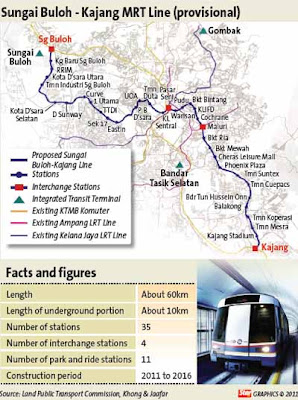
At the heart of the matter is the alignment of the MRT line, particularly where it should go, where it should stop, and lobbying have begun to have more than 9.5km of the first phase of the 60km Sg Buloh-Kajang line constructed underground.

The entire MRT line is estimated to run a total of 150km at a cost of RM36.6bil. Other lines will be added later. All these lines, together with the existing Star, LRT and Komuter rail will form part of the country's Urban Transport master plan.

At the session with business communities, developers who own shopping malls and commercial developments were lobbying for the line and station to be located at, or as close to their commercial properties as possible.

“We are willing to adopt' a station,” said a source from Uptown's See Hoy Chan Sdn Bhd over the telephone. The company is a different entity from See Hoy Chan Holdings Group which built Bandar Utama and the highly-popular 1 Utama mall. The owners of both companies are cousins.

Uptown's See Hoy Chan is planning to develop the second phase of what is already a densely populated commercial area in Damansara Utama popularly known as Damansara Uptown.

The company plans to build several blocks of offices and serviced apartments on 12 acres. That site is currently being used as a car park.

Damansara Uptown has a working population of about 30,000. Once the 12-acre commercial project is completed, the number will swell by 20,000 to 50,000.

Over in Kuala Lumpur, the Low Yat group is lobbying for the line to be located close to its commercial properties in downtown shopping area Bukit Bintang, in the heart of the Golden Triangle of Kuala Lumpur.

But not all business communities share a common stance. Some fear commuters would use existing parking space at commercial and shopping complexes for using the MRT instead of going shopping.

See Hoy Chan Holdings would like to get in touch with resident associations in the PJ North area to lobby for the line to go underground from Kota Damansara to Bandar Utama station.

“The station can be located below Central Park in Bandar Utama if the line is constructed underground. That location can be turned into a transport hub to serve the vicinity,” said See Hoy Chan Holdings director Datuk Teo Chiang Kok.

“Most of the lines and stations in countries with MRT are located underground. The communities in Kota Damansara, along Persiaran Surian, Bandar Utama and neighbouring residential areas are already there. To build elevated lines over what is already a densely populated area would bring about negative impact on the entire area,” he said.

At the same dialogue, Sunway Damansara resident association representative Ngian Siew Siong appealed to Land Public Transport Commission (LPTC) to have the line go underground in the Kota Damansara area. LPTC is planning for a station to be located at Dataran Sunway, a highly congested area during peak hours. Ngian is also Sunway City Bhd managing director (property development).

Contrary to LPTC's views that the MRT system will boost property values, Ngian said that “the visual impact and the noise level over Persiaran Surian and the vicinity will affect property value there.”

“The MRT line is massive and noisy.”

“The various communities are already in existent. Where will the park and ride facilities be located? Do not look at just the alignment, consider having the line underground and having integrated connectivity,” Ngian said. Under the proposed Sg Buloh-Kajang line, 20% of the 9.5km will be underground.

LPTC CEO Mohd Nur Ismal Kamal said the cost would be five to 10 times higher on a per km basis if the line were to go underground, depending on geological conditions.

See Hoy Chan's Teo Chiang Kok said the area comprised laterite and building an underground line will only cost three to four times more.

Earlier, explaining the Government's rationale to build the system, LPTC general manager Amiruddin Maaris said the MRT would have 50% more carrying capacity than the LRT line and will also be 50% wider. One car train carrying capacity is equivalent to three buses, or that of 177 cars.

“It will ease congestion,” he said.

The MRT system is expected to create 130,000 jobs and bring about a huge multiplier effect from its construction and operation. But the vision to bring out the flavour of KL metropolis, which to many, remains dormant because of the lack of public transport and connectivity, Amiruddin said.

Although tendering is expected to begin in April, the alignment can still be tweaked to accommodate the views of the public.

“This is just the proposed line. We will have other sessions to hear the public's views,” said Mohd Nur.

Said a public transport specialist: “Let us learn from the mistakes of the Light Rail Transit and the Star line.”

By The Star

ADS

Better transport system, affordable housing in 2011?

ADS

The MRT system should integrate seamlesly with other existing modes of transport such as the KL monorail.

2011 can be a year for the common folks and real estate industry players to celebrate if more timely efforts are expended to improve the overall living, working and leisure environment in our cities.

There are a number of initiatives that need to be undertaken to further shore up the quality of living for the people.

Top of the list is without doubt the dire need for a highly efficient and functional public transport system that will ensure the optimum integration and utilisation of the various modes of transport and infrastructure. The grossly inefficient public transport system in our cities now is the reason why our roads are so heavily congested as the people have no choice but to drive.

Most environment-conscious cities around the world are clamping down on the number of vehicles in their cities to reduce vehicular pollution and their carbon footprint. Malaysian cities should follow suit and timely action should be taken now to ensure we are not left behind in the pursuit of clean environment. The plan for the much-awaited mass rapid transport (MRT) system in the Greater KL (GKL) area should be accorded fast-track priority and the project should get off the ground as soon as possible. All efforts should be taken to ensure the project will not turn into a white elephant (built at a high cost and under-utilised) which could well be if it fails to integrate seamlessly with other existing modes of transport such as the light rail transit, monorail, public buses, taxis and other transport system.

With petrol prices expected to go up further with the lowering of government fuel subsidy in the coming days, having a world-class public transport system that is operated efficiently will be a big boost to the liveability of our cities including Kuala Lumpur, Petaling Jaya, Subang Jaya and Shah Alam. In order for the MRT project to be a big success, the cost should be kept down so that its operation will not be over-commercialised and profit oriented. The fares should be kept affordable for the common folks in order to ensure it will be widely used.

The proposed redevelopment of the sprawling Rubber Research Institute (RRI) land in Sungei Buloh and the Sungei Besi military airport land among others is a good opportunity to undertake a holistic master planning for a top-notch public transport system that will serve all the well-populated parts of our cities. The success of the project in the GKL should become a model to improve the public transport system in other cities country-wide to keep up with the rapid urbanisation and needs of the people. Cities like George Town, Malacca and Johor Baru are also in need of much better public transport system to move forward.

Quality infrastructure projects, including good public transport system, will without doubt spawn more well-planned real estate projects and townships that will ease the shortage of supply of a broad range of quality housing products, especially affordable housing units. Ideally, there should be a greater emphasis on quality housing projects versus commercial projects in these developments since there is a shortage of good housing units now and a glut of commercial space, especially office buildings.

Another timely initiative will be to enlarge the role of the national housing company or Syarikat Perumahan Negara Bhd (SPNB) to be more proactive as the appointed agency to be responsible for providing enough affordable housing units for the lower and middle income groups. There is currently a severe shortage of affordable housing projects in good locations as many developers are busying themselves with higher-priced niche lifestyle projects that offer higher premiums to their bottomlines.

So the vacuum in the affordable housing sector should be filled by SPNB in concert with the various state housing authorities. A national census or survey should be undertaken to gather and compile all the necessary statistics on the actual number of affordable houses that are still needed and to ensure enough of such housing units are build for the people. With the sharp escalation in house prices in many parts of the country, including the GKL, Penang and Johor, many average income earners are unable to buy a house now.

As the Government is opening up more land, including the RRI land in Sungei Buloh and the Sungei Besi airport land for redevelopment, SPNB should take the opportunity to work with the appointed organisations the Employees Provident Fund for the RRI land and 1Malaysia Development Bhd for the Sungei Besi land to submit plans for affordable housing needs in these projects.

With the huge demand, at least 20% to 30% of the land should be allocated to build housing units priced between RM200,000 to RM300,000. If SPNB is unable to undertake this role for whatever reason, a proper national housing board (like the one in Singapore) should be established touphold the public housing needs.

Deputy news editor Angie Ng believes that to achieve anything worthy, it is time to cast out rhetoric and slogans, and get on with real action.

By The Star (by Angie Ng)

ADS

MRT project to generate billion$ in GNI

ADS
The implementation of the mass rapid transit (MRT) project in the Klang Valley is expected to generate a Gross National Income (GNI) of between RM3 billion and RM4 billion beginning next year until 2020, said Prime Minister Datuk Seri Najib Tun Razak.

He said between RM8 billion and RM12 billion was expected to be generated in terms of spinoffs from the construction of the MRT project.

"RM21 billion in GNI incremental impact is anticipated to be generated in 2020 from the value appreciation of the project and increase in productivity rate," Najib told a press conference at the Royal Malaysian Air Force base in Subang before his departure to Kuala Terengganu for a one-day official visit.

The Prime Minister said the Cabinet had approved the implementation of the MRT project at its weekly meeting on Friday.

The MRT, the largest infrastructure project in Malaysia, is an economic entry point project identified for the Greater Kuala Lumpur/Klang Valley National Key Economic Area under the Economic Transformation Programme.

Najib also said the MRT project would generate 130,000 jobs during the duration of its construction which was expected to commence July next year and be complete in five to six years.

Once operational, the MRT will first ply the Sungai Buloh to Kajang route via the Kuala Lumpur city centre.

"The travel distance is about 60km and 35 MRT stations will be built along that route. Integrated stations would be built in locations where the MRT overlaps KTM Commuter, Kelana Jaya and Ampang Light Rail Transit (LRT) routes," he explained.

The Sungai Buloh-Kajang MRT will provide efficient train service to 1.2 million people, he said, adding that it would serve densely populated Kota Damansara, Mutiara Damansara, Bandar Utama, Taman Tun Dr Ismail, Bukit Damansara, Cheras, Bandar Tun Hussein Onn and Balakong.

Najib also said more than 400,000 commuters would benefit from the Sungai Buloh-Kajang MRT service daily.

The routes and locations for the MRT have yet to be finalised and value management studies would be conducted taking into account the optimum utilisation rate and maximum real estate realisation value.

As such, he said the actual project cost can only be determined once the value management studies are completed.

"The entire cost of building the project is being fine-tuned. Initial estimates made in 2009 placed the figure at about RM36 billion but this was subject to changes," Najib said.

The Prime Minister said the final cost of the project would depend on factors such as the awarding of contracts through open tender, the escalating cost of raw materials and others.

The Prime Minister also added the government decided on kicking off the project with the Sungai Buloh-Kajang route as this corridor did not have adequate rail transport service.

Indepth studies were also carried out on this route which was proposed by Syarikat Prasarana Negara Bhd in 2008 and by MMC-Gamuda Joint Venture Sdn Bhd recently.

The Sungai Buloh-Kajang MRT will built under phase one of the MRT network in the Klang Valley.

Future routes to be developed gradually over several stages have been proposed and is being studied under the Urban Public Transportation Masterplan, he said.

Asked if any new entry points projects would be unveiled, Najib said several projects would be announced in January.

By Bernama

ADS

Qatar MRT project on Gamuda's radar

ADS
GAMUDA Bhd said it is eyeing opportunities in the massive US$45 billion (RM141 billion) mass rapid transit (MRT) project Qatar is planning to build next year.

Qatar is building the new infrastructure as it prepares to host the 2022 Fifa World Cup finals.


Gamuda group managing director Datuk Lin Yun Ling said the MRT system will be part capital city Doha's key transport infrastructure.

"The Qatari government needs the entire system to host the event and tender is expected to be announced next year, and when that happens, Gamuda will be ready to submit its tender," Lin told reporters after its shareholders' meeting in Shah Alam, Selangor, yesterday.
Lin said Gamuda has a good track record and is well-positioned to take part in construction projects in the Middle East, especially in Qatar as it is involved in the ongoing construction of the New Doha International Airport.

Gamuda's other on-going projects in the Middle East include the Dukhan highway in Qatar and the Sitra causeway bridges in Bahrain which are due to be completed by year-end.

On its property development projects, Lin said the company expects to rake in a record RM1 billion worth of sales this year and another RM800 million in unbilled sales.

Gamuda is anticipating total sales of RM5 billion in the next two years, of which RM2 billion will be from local sales while the remaining RM3 billion from its Gamuda City project in Hanoi.

"The property market is hot at the moment due to low interest rates, and banks have a lot of loan provisions on this sector and people do not want to sit on cash and lose its value preferring to get involved in assets.

"Our landbank is ample and our priority is also to sell low-yielding landbank and develop innovative developments for other strategic landbanks." Lin added.

On the greater KL MRT project, Lin said the Cabinet has yet to approve its joint proposal with MMC Corp Bhd.

He said the government, Prasarana (Syarikat Prasarana Negara Bhd) and Spad (Land Public Transport Commission) will decide on the location of train stations, railway alignment, railway network and get feedback from the public and other stakeholders before Gamuda and MMC take up the offer to deliver the RM45 billion project.

By Business Times

ADS

Scond stage of LRT extension project estimated at RM1.7bil

ADS

The tender for the facilities works under Package B for both the Kelana Jaya and Ampang lines would be called upon approval of the final railway scheme, which is expected by mid-2011. — AFP

PETALING JAYA: Although the contract awards for the first phase (Package A) of the light rail transit (LRT) extension project have eluded the big construction players, the big boys will have another chance to bid for phase two (Package B), which is estimated to be worth about RM1.7bil, by the middle of next year.

On Nov 26, Syarikat Prasarana Negara Bhd (SPNB) awarded contracts worth RM1.7bil for Package A of the RM7bil LRT extension project involving the Kelana Jaya and Ampang lines.

The main contract of Package A of the Kelana Jaya line, valued at RM950mil, was awarded to Trans Resources Corp Sdn Bhd (TRC). UEM Builders Bhd and Intria Bina Sdn Bhd jointly won the sub-contract works worth RM93.2mil.

For the Package A Ampang line extension project, Bina Puri Holdings Bhd and Tim Sekata were jointly awarded the main contract and sub-contract works worth RM634.6mil and RM67.7mil respectively.

RHB Research Institute said that other players could still bid for jobs under phase two of the LRT extension project.

It looks like the first phase of the LRT line extension work packages have eluded big names such as Gamuda Bhd, IJM Corp Bhd (IJM), WCT Bhd, Sunway Holdings Bhd and Malaysian Resources Corp Bhd (MRCB).

However, there is always a second chance for these pre-qualified main contractors and sub-contractors to bid for the remaining works, it said in a recent report.

The first phase of the Kelana Jaya line would be a 9.2km extension from the Kelana Jaya station to Summit. The second phase would involve a 7.8km extension from Summit to Putra Heights.

Package A of the Ampang line involves a new 7.4km stretch from the Seri Petaling station to Station No. 5, while Package B would see a 10.3km extension from Station No. 5 to Putra Heights.

According to SPNB, the tender for the facilities works under Package B for both lines would be called upon approval of the final railway scheme, which is expected by mid-2011.

We estimate that the remaining work packages are worth about RM1.7bil as well, said RHB Research.

IJM and MRCB told StarBiz that they would be participating in the tender for Package B of the LRT extension project.

Kenanga Research said there were still contracts of significant value yet to be awarded under Package A of the LRT extension project.

Based on the newsflow, Package A for the Ampang line could be valued at RM1.5bil and Kelana Jaya line at RM1.9bil. With the recent contract awards to Bina Puri and TRC, there will be projects worth another RM600mil and RM800mil respectively left to be awarded in the short term, it said in a report.

By The Star

ADS

On the fast track

ADS

Several companies made presentations to the National Key Economic Area (NKEA) lab about three months ago on the Kuala Lumpur-Singapore high-speed train project, industry sources say.

Among them were YTL Corp Bhd and Hartasuma Sdn Bhd, which was said to be partnering a Chinese state-owned firm.

Hartasuma, a Class "A" Bumiputera contractor, is a member of Ara Group, founded by Datuk Aisamar Kadil Mydin Syed Marikiah and Tan Sri Ravindran Menon, director and executive director of Subang SkyPark Sdn Bhd respectively.

Its track record includes repair and overhaul of passenger coaches for KTM Bhd and civil works (Kuala Kubu Baru-Tanjung Malim Halt) for the Rawang-Ipoh electrified double tracks.

Business Times understands that some of the companies have proposed to undertake the high-speed rail project for between RM8 billion and RM14 billion.
A government source said the project could be worth RM10 billion to RM12 billion and that it would take five to eight years to complete as it will cover 300km.

The source said that cost would depend on the type of technology deployed, whether it is magnetic levitation (maglev) or conventional, and how the tracks are aligned.

Maglev will cost more than conventional, but requires less maintenance, is safer and faster. The system also uses more electronics and essentially involves "non-contact electromagnetic levitation".

"If the alignment is built along the coastal road, then it would involve a lot of land acquisition and this would add to the cost," he said.

The source added that the project would depend on a study by the Treasury, the Performance and Delivery Unit (Pemandu) and other government agencies.

It is believed that Pemandu, which is leading the NKEA lab, has invited officials from the Ministry of Transport, the Land Public Transport Commission (Spad) and City Hall to attend briefings held separately by the companies.

The high-speed train project was mooted by YTL in 2006. It had proposed to undertake the project for RM9 billion, partnering Germany's Siemens, a global expert in high-speed rail technology.

The YTL proposal, however, was shot down because of the high cost involved.

Malaysia is mulling over a high-speed rail linking Kuala Lumpur and Singapore that will cut travel time between the two cities to 90 minutes.

Plans would require the approval of Singapore, which has expressed its interest in the project. However, the government has not given a firm approval, the source said.

By Business Times

ADS

Move to make KL most livable city by 2020

ADS

The aim to make Greater Kuala Lumpur a sustainable and livable city can easily be achieved with high-quality infrastructure, green spaces and developing inner city residential areas.

Minister of Federal Territories and Urban Wellbeing Datuk Raja Nong Chik Datuk Raja Zainal Abidin said a flexible strategic vision was necessary to foster competitiveness and build a comprehensive transportation linkage and network in the area.

He said projects like the RM40 billion mass rapid transit system (MRT), increasing pedestrian walkways and the Klang River beautification project to promote recreation, urban revitalisation and real- estate development will contribute in making Kuala Lumpur one of the most livable cities in the world by 2020.

"The Tenth Malaysia Plan has dedicated a whole chapter on the building of an environment that enhances the quality of life. We are encouraging better city designs and innovations," Raja Nong Chik said in his speech at the opening of the 2nd International Conference on World Class Sustainable Cities 2010 in Kuala Lumpur yesterday.

A sustainable city is a city designed with consideration of environmental impact to improve the quality of life. This includes ecological, cultural, political, institutional, social and economic components, without leaving a burden on the future generations.

"A thriving city will continue to grow. It is therefore vital to properly plan a city to meet future needs and challenges," he said.

The Greater KL is one of the National Key Economic Areas. It is expected to increase gross national income contribution from RM258 billion to RM650 billion per year.

The government wants to achieve top-20 ranking in the EIU Liveability Index Survey and grow the population from six million to 10 million, with a focus on growing the foreign talent base from 9 per cent to 20 per cent of the population.

By Business Times

ADS

RM850m for infrastructure support

ADS

The Government will allocate RM850 million for infrastructure support to accelerate corridor and regional development in the country.

Prime Minister Datuk Seri Najib Razak, in his Budget 2011 speech, said the focus will be on several clusters with specialisation and geographical advantages.

Iskandar Malaysia will get RM339 million for the construction of highways, development of housing areas as well as providing and improving public transportation services.

Najib said the amount of investment committed by the private sector in the southern Johor region was RM62 billion as at June 2010, surpassing the targeted RM47 billion. Total actual investment in the same period was RM25 billion.

The Northern Corridor Economic Region will get RM133 million, which includes the development of an agricultural products processing centre, tourism infrastructure and a biotechnology incubator centre.

For the East Coast Economic Region, RM178 million is set aside for projects including industrial parks, water treatment plants, development of tourist areas as well as redevelopment of former Pahang Tenggara Development Authority and Jengka Region Development Authority areas.

Sarawak Corridor of Renewable Energy will receive RM93 million for facilities including telecommunication, water supplies, airport and roads as well as halal food industrial parks.

For the Sabah Development Corridor, a sum of RM110 million is allocated, among others, for palm oil industry cluster projects, agro-industrial precinct and integrated farming centre.

By Business Times

ADS

Multi-billion projects in the pipeline

ADS
PETALING JAYA: The Government has earmarked several multi-billion projects that will see the construction of several highways, a mass rapid transit (MRT) system, and the Kuala Lumpur International Financial District (KLIFD) amongst others, to be kicked off next year.

Generally, the planned development is well-received by the construction sector.

Prime Minister Datuk Seri Najib Tun Razak yesterday said in the Budget 2011 speech that under the public-private partnership (PPP) initiatives, several projects under the 10th Malaysia Plan would be implemented next year through private investment of RM12.5bil.

The Government had allocated RM1bil from the facilitation fund.

Among the PPP projects mentioned are the construction of several highways and 300-megawatt combined-cycle gas power plant in Kimanis, Sabah.

Others are the International Islamic University Malaysia Teaching Hospital, the Women and Children’s Hospital, Integrated Health Research Institute Complex in Kuala Lumpur and Academic Medical Centre.

Additionally, high-impact strategic developments were also identified.

The first is RM26bil KLIFD where the Government is prepared to consider special incentive packages to attract investors to the KLIFD.

Next, is the MRT in Greater KL with an estimated private investment of RM40bil which is expected to be completed by 2020.

Also, the mixed-development of the Malaysian Rubber Board (MRB) land in Sungai Buloh to be undertaken by the Employees Provident Fund (EPF).

This is to be completed by 2025 and the development is estimated at RM10bil.

Finally is the development of another landmark building, a RM5bil 100-storey tower, Warisan Merdeka to be developed by Permodalan Nasional to be completed by 2020.

Master Builders Association of Malaysia (MBAM) was appreciative that the Government would focus on many construction projects under Budget 2011.

Its president Kwan Foh Kwai hoped the Government would ensure the speedy award and efficient implementation of high impact projects.

“Any delay in implementation, will mean additional costs to the project,” he said in a statement yesterday.

Additionally, StarBizWeek also contacted Kwan to ask on possible shortage of construction capacity such as professional and labour workforce as well as raw materials due to the implementation of the mega-size projects.

“Because most of the projects are spanned across 10 years on average, we do not expect to experience any shortage on professionals such as engineers and architects as well as raw materials.

“The current demand of raw materials are also within the capacity of suppliers,” he said. But, Kwan was a little bit concern on labour workforce as the industry now was over-reliant on foreign workers.

“That is why MBAM supports the initiative to reshape the economy through a focus on intensifying human capital development, vocational training and improving lifelong education that will help improve the labour force in Malaysia,” he said.

Meanwhile, EPF chief economist Norashikin Abdul Hamid said the development of MRB land by EPF was expected to boost the economy and the construction sector in particular.

“The Government’s decision in selecting EPF to enter into a joint-venture with the Federal Government to develop the land has been weighed and deliberated carefully, given EPF’s strong financial position,” she said.

UEM Land Bhd director of finance, corporate affairs and investment Mohd Zakir Omar supported the PPP concept and the company had been pursuing to the Government a number of projects in the past few years involving property development.

By The Star

ADS

Budget 2010/2011: Major infrastructure boost

ADS
KUALA LUMPUR: The government made good its commitment to forge ahead with major infrastructure, construction, and oil and gas-related projects under the Tenth Malaysia Plan when the Budget 2011 proposals were unveiled on Friday, Oct 15.

Among them are the Mass Rapid Transit (MRT) in Greater KL; a 100-storey skyscraper in the heart of Kuala Lumpur and a regasification project in Malacca.

These projects would be a boon to infrastructure and construction players, as well as those providing oil and gas support services, fabricators and those specialising in pipe-coating services.

For the MRT project to be implemented next year, the estimated private sector investment is to the tune of RM40 billion. The project is envisaged to be completed by the year 2020 and is expected to increase utilisation of public transportation by at least 40%.

Permodalan Nasional Bhd will undertake development of the integrated Warisan Merdeka, including a 100-storey skyscraper that would be the tallest building in the country, at a cost of RM5 billion. The tower will be completed in 2015, and the project would retain the Merdeka Stadium and Stadium Negara as national heritage sites.

Another mammoth project is the RM10 billion Sungai Buloh project at the current Malaysian Rubber Board land covering an area of 2,680 acres. The Employees Provident Fund will develop this project.

As the oil and gas, and energy sectors remain among the major contributors towards the national economy, the government has pledged RM146 million to support the sector and expand downstream activities.

Towards this, the government proposed an oilfield services and equipment centre in Johor that will be built at a cost of RM6 billion via private investment.

Also, Petroliam Nasional Bhd would undertake a proposed RM3 billion regasification project in Malacca, to be operational by 2012.

By The EDGE Malaysia

ADS

IJM and UEM may jointly bid for MRT project

ADS
PETALING JAYA: Speculation is rife that IJM Corp Bhd and UEM Group Bhd may jointly submit to the Government a proposal for the mass rapid transit (MRT) system.

Currently, it is understood that the only MRT proposal that has been submitted to the Government is the RM36bil proposal by Gamuda Bhd and MMC Corp Bhd.

RHB Research Institute said there were strong rumours in the market that IJM and UEM, via a joint-venture (JV), had submitted or would submit an alternative MRT proposal carrying a much cheaper price tag to the Government, competing head-on with the Gamuda-MMC JV.

The research house’s checks with IJM yielded this response: “It is always difficult to comment on rumours.”

Meanwhile, UEM, when asked by StarBiz on the matter, replied:

“We do not comment on rumours and speculation though as mentioned in July, we would be interested to submit a bid if the MRT project is open for tender.” RHB Research said while theoretically open bidding should ensure the best value for money, it suspected that “urgency” might take precedence in the case of this MRT project.

“We equate the MRT project to the backbone of the Greater KL National Key Economic Area (NKEA) under the Economic Transformation Programme (ETP).

“Thus, we are unsure if the Government can afford to spend a few extra months to evaluate an alternative proposal,” it said in a report yesterday.

Nevertheless, RHB Research believed that most, if not all, related players would benefit from the MRT project given the sheer size of the project, as long as it got off the ground.

“In any case, the Gamuda-MMC JV already said that it only intends to keep the tunneling works that make up about 30% of total project value with the remaining 70% to be awarded out to other players on a competitive basis,” it said.

By The Star

ADS

MRT will boost property prices

ADS

PETALING JAYA: The proposed mass rapid transit (MRT) system is expected to be one of the main contributing factors to boost property prices adjacent to the MRT stations.

CB Richard Ellis (M) Sdn Bhd executive director Paul Khong said the MRT stations generally had a positive impact on nearby property values in most cases.

“Being next to the station works well for lower and middle-end residential neighbourhoods and all commercial offices or retail malls. This basically translates to better public transportation and enhanced accessibility to the relevant vicinities,” he told StarBiz.

“The MRT will benefit the lower to middle-end users the most and it makes travelling faster, cheaper and much easier.”

On the expected quantum capital appreciation due to the MRT stations, Khong said it could be 10% to 15%.

“More importantly, the MRT station must be less than a 1O-minute walk from the properties. Ultimately, being next door and within five minutes away will be a premium.

“Anything more will give less impact in terms of capital values,” he said. “Being next to a MRT station could be the main selling point for a new project, be it a commercial or a residential one. A good example will be Menara UOA in Bangsar.”

But, Khong said, the property prices could be affected if it was alongside the MRT tracks and not the station. “The crucial point is to be close or next to the station if possible,” he said.

The RM36bil MRT system proposal by Gamuda Bhd and MMC Corp Bhd will have up to three main lines. The first line will run through Sungai Buloh, Kota Damansara, Kuala Lumpur and Cheras (right up to Kajang).

The second line will connect Sungai Buloh, Kepong, Kuala Lumpur and Serdang, while the third line will loop around Kuala Lumpur’s business district – providing a link between the monorail and light rail transit (LRT) services.

The Gamuda-MMC proposal is currently undergoing technical study by a consultant and should be completed by mid-month to be presented to the Government.

At this point in time, there is no information on the exact locations of the proposed MRT stations.

According to property consultancy Khong & Jaafar Sdn Bhd managing director Elvin Fernandez, most of the areas around the LRT stations have been developed and it is axiomatic that accessibility would improve property values.

“But the impact wouldn’t be immediate as the MRT will take time to complete and the effect will be evident only from details of the exact positions of the rails and stations filtering into the market in time to come,” he said.

Based on preliminary details of the MRT, Fernandez said the Sungai Buloh area (the Guthrie Corridor townships) and the proposed Rubber Research Institute Malaysia developments could be among the first beneficiaries because both lines were expected to start from there.

“Kajang and Seri Kembangan are the next areas to flourish as they are on the other end of the line. Additionally, the Cheras corridor also has good prospects,” he said.

Nevertheless, Fernandez said, some developments might be negatively affected, especially residential developments, due to the noise or congestion if they were close to the rail lines or stations.

“But generally, the MRT should bring positive effects to the nearby areas,” he said.

According to a market source, another area that would have potential based on the proposed MRT system was the Kota Damansara corridor.

“The Kota Damansara corridor includes Kota Damansara, Mutiara Damansara, Damansara Perdana and The Curve. Business and financial districts along Jalan Raja Chulan, Jalan Bukit Bintang and Suria KLCC also have good prospects,” said the source.

By The Star

ADS
 

Most Reading